Anonymous file hosting, what still works and what it costs you
Search anonymous file hosting and you'll get two dozen pages listing the same eight sites, most of which shut down, changed hands or started requiring an email address since the article was written. The category has a mortality rate.
Three different people run this search and they need opposite advice, so start by working out which one you are.
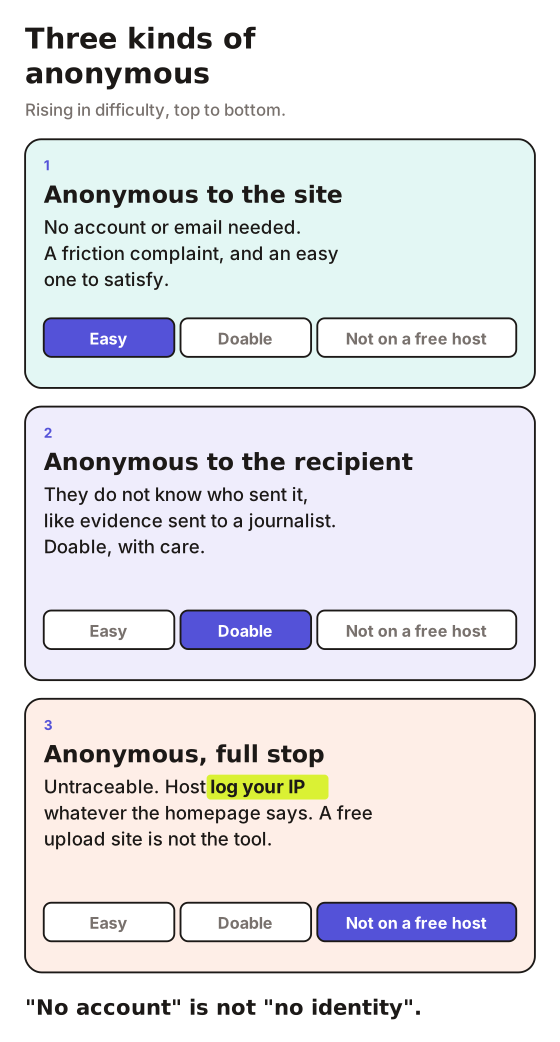
Anonymous to the site, anonymous to the recipient, or anonymous full stop
Most people mean the first one. You have a file, you want a link, you do not want to make an account or hand over an email address to get one. That's a friction complaint, not a privacy requirement, and it's easy to satisfy. If the file is a PDF and you are weighing up free PDF hosting and where it breaks, that has its own write-up.
The second group wants the recipient not to know who sent it. Harder, but doable, and usually legitimate: someone passing evidence to a journalist, or sharing a document with a lawyer before they've decided whether to act on it.
The third wants to be untraceable. That's the one every listicle implies and none of them deliver. The host logs your IP whether their homepage says "anonymous" or not, because they need it to handle abuse complaints and because their upstream provider requires it. "No logs" on a free file host is a marketing claim with nothing behind it. If your safety depends on it, a free upload site is not your tool and I'm not going to pretend otherwise.
Everything below is written for the first two.
The category keeps dying, and the reason tells you something
AnonFiles was the best known of these sites and it shut down in 2023. The operators said plainly that the abuse had become unmanageable: the service had turned into a distribution channel for malware and stolen credentials, and moderating it had stopped being possible. They pulled it rather than keep going.
That's the pattern. A site launches with genuinely no-friction anonymous uploads. Malware operators find it within weeks, because a clean-looking direct download link is worth real money to them. The host's domain lands on blocklists, the payment processor gets nervous, and the site either starts demanding accounts or disappears.
So when you pick one of these, you're picking a thing that may not exist next year, and the link you sent may stop working before your recipient clicks it. Plan for that. Do not use an anonymous host as the only copy of anything.
What's still standing
Gofile is the closest thing to a default. Upload without an account, get a link, files stay while people keep downloading them. No hard size cap on a single file, which is genuinely unusual. The trade is that it's ad-supported and the download page can be a bit of a minefield for a non-technical recipient, who will be presented with several buttons and only one of them is the file.
Catbox has been running for years, which in this category is close to remarkable. It's built for small files and image or clip hosting rather than a 4GB video, it keeps them permanently by default, and there's a temporary sibling for files you want gone in a few hours. No account, no ceremony. The interface looks like 2009 and I mean that as a compliment.
file.io does the disappearing trick properly: by default the file is deleted after the first download, so the link genuinely dies on use rather than promising to. That's the one I'd reach for if the "anonymous" part is really about the file not lingering somewhere for the next decade.
0x0.st and its various clones will take a file from a single curl command and hand back a URL. If you're comfortable in a terminal it's the fastest option on this page by some distance. If you aren't, ignore it.
None of these tell you who downloaded your file, or whether anyone did. That's the deal you're making.
Anonymity cuts both ways and people forget the second cut
You wanted to stay unidentified. Fine. But the same design means you cannot see anything either.
You do not know if the link was opened. You do not know if it was opened by the person you sent it to or by whoever they forwarded it to. You cannot switch it off after the fact, because there's no account holding the file, which means there's no you to revoke it. On most of these sites, once a link is out there, it's out there until the site decides otherwise.
For a meme, that's fine. For a contract draft going to the other side's solicitor, that's a genuinely bad trade and people make it anyway because the upload took four seconds.
When you want no account, not no identity
If you're sending a document to a client, a prospect or a partner, you're not anonymous to them. They know exactly who you are, that's the point. The thing you were avoiding was the signup wall, and you've accidentally landed on tools built for a completely different problem, which is why you've now got a link with no expiry, no analytics and an ad-covered download page in front of your proposal.
For that job, use something built for sending documents to named people. Uploading files without registering covers the low-friction options, and if you want the file to stay yours after you send it, anonymous document sharing goes into the difference between hiding your identity and controlling your document.
LiveDocument sits at the opposite end of this spectrum and I should be clear about that, since we build it. It's the deliberate opposite of anonymous: you record a video walkthrough, it sits alongside your PDF or image behind one link, and you see which pages they actually spent time on. Links can be expired and revoked, so a share dies when the deal does. It is not anonymous hosting and it is not storage, and if the entire point of your search was that nobody should know who sent the file, it is the wrong tool and you should ignore this paragraph.
Common questions about anonymous file hosting sites
Is anonymous file hosting legal?
Uploading and sharing your own files anonymously is legal in the UK and most jurisdictions. What you share is a separate question, and the hosts cooperate with law enforcement when it comes up. The anonymity is from other users, not from a court order.
Can anonymous file hosts see my IP address?
Yes. Effectively all of them log it, whatever the homepage says, because they need it for abuse handling and their upstream providers require it. Treat "anonymous" as meaning "no account required", not "untraceable".
What replaced AnonFiles?
Gofile picked up most of the traffic, with Catbox and file.io taking the smaller-file and single-download use cases. None of them are a like-for-like replacement, and given how the last one ended, I wouldn't build a workflow that depends on any single one of them.
About the Author
Cameron JamesCameron is the founder of LiveDocument. He writes about sharing documents, PDFs, decks and contracts, and why pairing a video walkthrough with a document beats sending it cold.