
Goals in sales that a rep can actually control
Most advice on goals in sales gets the problem backwards. It treats a missed target as a motivation problem, when the bigger problem is usually measurement.
The numbers back that up. Qobra's write-up of quota attainment benchmarks cites Salesforce's State of Sales research, which found only 28% of reps hit their annual quota, the lowest figure in six years. When that many people miss, "why aren't they hungry enough?" is the wrong first question. Ask what exactly you're asking them to control.
I do the outbound for LiveDocument myself, and I sat through enough post-mortems in earlier growth roles to know the script: more pipeline, more urgency, more calls. But if the goals in sales aren't broken down into weekly inputs a rep can move, you're not managing performance. You're grading the weather.
Why most sales goals fail before the quarter starts
Most sales goals fail before anyone sends the first email. The number goes on the board, leadership calls it ambitious, and everyone pretends the route to it is obvious. It usually isn't.
A rep doesn't directly control closed revenue in the short term. They influence it. What they do control is activity quality, pipeline creation, stage progression and deal hygiene. If those aren't tracked tightly, the quarter follows a familiar script: the first stretch looks fine, the middle goes wobbly, and the final stretch turns into discounts and bad decisions.
Revenue is a lagging outcome, not a weekly goal
Revenue matters most, and it's also one of the worst weekly coaching metrics.
Start with the controllable layer instead. Track the inputs that produce pipeline, the pipeline that produces deals, and the deal movement that keeps your forecast honest. If you sell through more than one motion, that also means being straight about your channel mix for B2B sales, because weak channel design gets misread as weak rep execution all the time.
Practical rule: If a rep can miss the goal while doing the right work, the goal is too far downstream for weekly management.
A goal built this way is reviewed weekly and tied to a specific action when it slips. That's planning, not scoreboard watching, and it's the difference between a plan and a slogan. I've written more on that in strategic planning in sales.
The four goal categories that cover a sales team
You don't need fifteen categories. You need four, and if you skip one you'll cover the gap with hope, which is the most expensive tool in sales.
Pipeline goals tell you whether enough future revenue exists. Conversion goals tell you whether that pipeline is any good. Deal velocity tells you whether timing risk is building. Retention and expansion goals stop the team acting as if new logos are the whole business.
| Goal category | Primary metric | Starting point | Most common mistake |
|---|---|---|---|
| Pipeline coverage | Qualified pipeline to quota ratio | Around 3x at quarter start, a common rule of thumb to test against your own win rate | Counting junk opportunities to make the dashboard feel safe |
| Conversion | Win rate or one stage-to-stage rate | A stable baseline from your own funnel | Tracking too many ratios and learning nothing |
| Deal velocity | Average days from qualified opportunity to closed-won | Short enough to support the quarter without late-stage panic | Treating slow deals as inevitable instead of diagnosable |
| Retention and expansion | Net revenue retention, logo retention or expansion revenue | A target tied to the book of business and who owns it | Leaving post-sale revenue out of the sales goal model |
Pipeline first, because nothing else works without it
I start with roughly 3x pipeline coverage for quarter planning. It isn't magic, but it forces honesty. If the quota says one thing and the qualified pipeline says another, the pipeline is usually the one telling the truth.
Conversion needs restraint. Pick one main rate per funnel rather than a dozen percentages. The point is to spot where deals die, not to build a museum of CRM charts.
Deal velocity is where hidden quarter risk shows up. A long cycle isn't only a timing problem. It lowers revenue per day, makes the forecast wobble and makes late-quarter heroics more likely.
Retention and expansion belong here too, and too many teams treat them as an account management side quest. If account managers or customer success own revenue, those motions need real goals, not polite encouragement.
Turning a vague target into a measurable sales goal
"Hit $1.2M this quarter" might matter to finance. It doesn't tell a rep what to do on Monday morning. The fix is to work backwards.
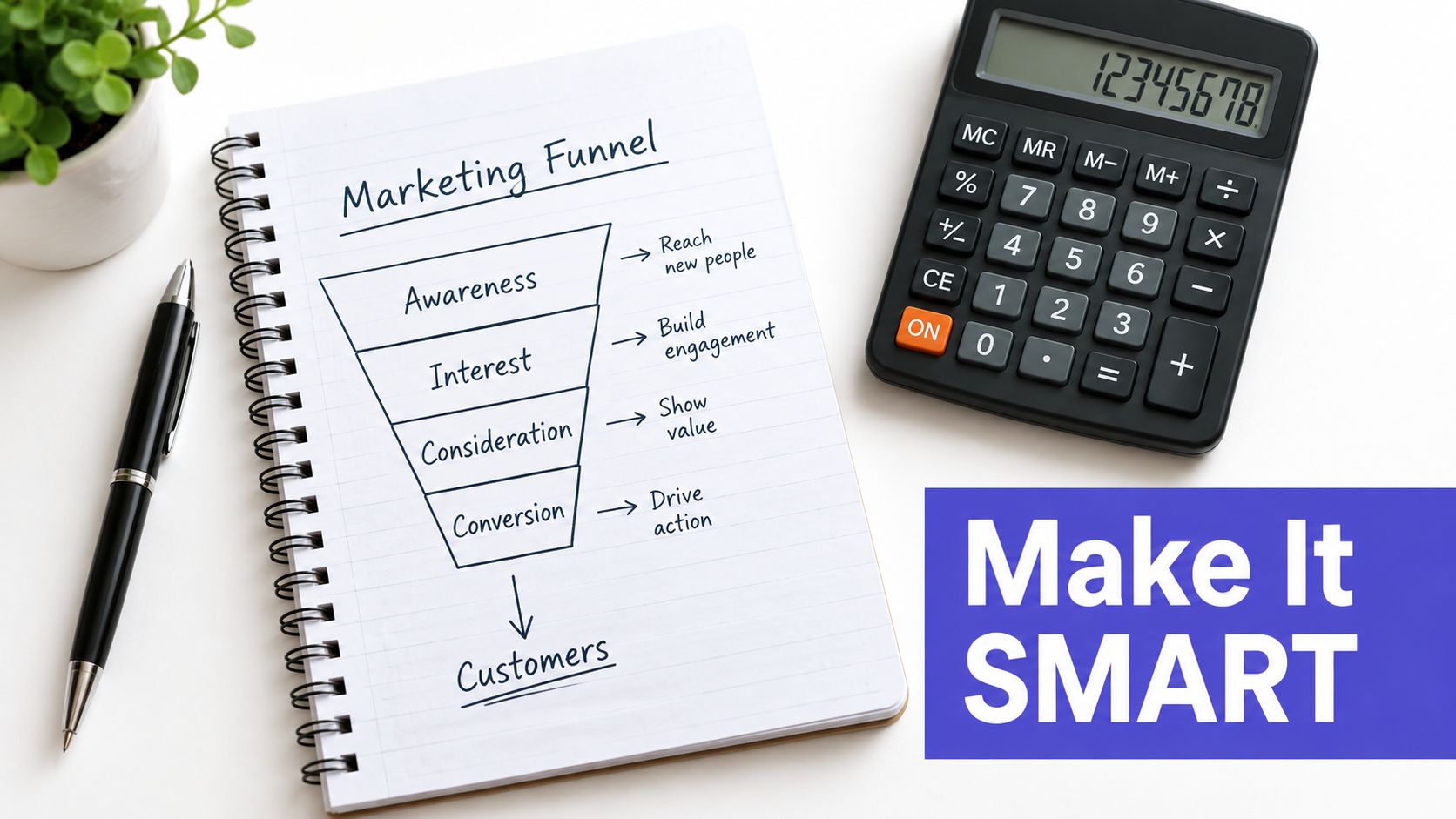
SMART only helps if the maths comes first
SMART still holds up: Specific, Measurable, Achievable, Relevant, Time-bound. The trouble is that teams use it as formatting. They tidy the sentence and skip the operating logic.
Start with the revenue target. Translate it into required deals, then qualified opportunities, then discovery meetings, using your own average contract value and your own historical conversion rates. I won't invent numbers where yours should go, because the maths has to come from your funnel and not from a generic benchmark post.
Once you've done that, each letter becomes practical:
- Specific: "Create 18 qualified opportunities" beats "build more pipeline".
- Measurable: Track it weekly in the CRM, not in a spreadsheet nobody updates.
- Achievable: Base it on recent output plus a sensible lift, not wishful thinking.
- Relevant: Check that hitting the input goal actually moves revenue.
- Time-bound: Weekly checkpoints, monthly review, quarterly close.
The weak link is usually the A
Goals rarely fail on specific or measurable. They fail on achievable. Teams either sand the number down until nobody objects, or crank it up and call it a stretch.
Qobra's guidance offers a useful calibration: a healthy plan has roughly 60% to 70% of reps clearing quota, and consistent attainment of 90% or more across the whole team often means quotas are set too soft. That reframes achievability as a calibration question, not a morale one.
If your goal doesn't change a rep's behaviour this week, it isn't a goal. It's office decor.
How pipeline, activity and revenue goals fit together
Plenty of teams accidentally create impossible jobs. They give an SDR a revenue-linked expectation, stack activity targets on top, then act surprised when quality drops. The layers have to fit together, or you haven't set goals in sales at all. You've handed out conflicting chores.
One quarter, one rep, one coherent stack
Take an illustrative SDR in a mid-market SaaS motion, with a $400K revenue target attached to the pipeline they help create. They don't own closed-won revenue directly, so the number has to cascade into pipeline, then meetings, then activity.
| Layer | Metric | Q1 target | Logic |
|---|---|---|---|
| Revenue contribution | Supported revenue target | $400K | Sets the commercial context for the quarter |
| Pipeline | Qualified pipeline created | Sized to support the revenue target with adequate coverage | A number the SDR can influence directly |
| Meetings | Qualified meetings booked | Based on your historical meeting-to-opportunity rate | Connects outreach to pipeline honestly |
| Activity | Calls, emails, follow-ups, account touches | Based on the meeting target and channel performance | Stops activity targets turning into random admin |
I've left the middle rows unfilled because your ratios matter more than my made-up example. The relationship is the fixed part: revenue informs pipeline, pipeline informs meetings, meetings inform activity.
Stacking goals without capacity planning is lazy management
Leadership adds another layer of targets without removing anything, then calls the inevitable miss an execution problem. It happens with OKRs and it happens with quotas.
If your SDR team is drowning in disconnected targets, look at the handoff points first. Usually the issue isn't effort. Nobody reverse-engineered the workload from the revenue model.
The same thing happens with sales cycle planning. Teams obsess over close dates and ignore the stage mechanics underneath them, which is why mapping the stages of a sales cycle matters. The stages show you where the target breaks before the quarter ends.
Tracking sales goals without drowning in dashboards
Most dashboards are too busy to be useful. They look impressive in board packs and are no help in one-to-ones. You don't need more charts. You need earlier warnings.

Six metrics are enough for a weekly check
If I were rebuilding a sales dashboard from scratch, I'd start with these six:
- Qualified pipeline added: New pipeline that meets your definition, not wishful CRM entries.
- Pipeline coverage: A quick read on whether future revenue is structurally supported.
- Stage conversion: One main measure showing where deals stall.
- Average deal cycle: Not because speed is noble, but because delay kills forecast credibility.
- Win rate: A reality check on deal quality and positioning.
- Quota attainment to date: A lagging signal, still worth keeping in view.
Everything else has to earn its place. Raw activity counts and email open rates usually go first, especially when they've become a proxy for effort rather than movement. If the real gap is in conversations, objection handling training will do more for outcomes than another report on sends and opens.
The weekly rhythm matters more than the dashboard
Pull the numbers on Monday morning. Write one sentence explaining the gap. Act on it before Friday.
That sentence forces a diagnosis. Not "pipeline is low", but "pipeline is low because stage two conversion dipped after we changed ICP targeting." Now you can coach, reassign, narrow focus or fix qualification.
In document-heavy sales, one place a signal can hide is the proposal or pricing PDF you sent. PDF analytics on a tracked link, like the one LiveDocument gives you, show which pages a buyer spent time on. That shows attention, not intent, so treat it as a prompt for a question ("did the pricing page raise a concern?") rather than proof that a deal is moving.
Fewer metrics means less theatre and better decisions. I'd take that trade every quarter.
The one habit that separates goal setters from goal hitters
The teams that keep missing by a little rarely need another motivational speech. They need one repeatable habit, and mine is a short Friday review. Fifteen minutes, no drama.

At the end of the week, the rep writes down three things:
- Which goal layer slipped: Activity, pipeline, conversion, velocity or retention.
- What caused it: A real cause, not a vague excuse.
- What changes on Monday: One concrete adjustment.
That's the whole thing. Not a manifesto, not a pipeline therapy session.
Start every one-to-one on pipeline health, not closed-won. Closed-won is the receipt. Pipeline is the kitchen.
This works because it turns goals in sales into a feedback loop. Small misses get caught before they compound into quarter-end panic. Leaders who over-index on revenue and under-use pipeline quality almost always find these reviews uncomfortable at first. Good. It usually means the team has been managing outcomes after the fact instead of the system that produces them.
There's a planning point underneath this too. Some teams aren't failing because targets are too tough. They're failing because targets arrive late and keep shifting, and you can't build accountability on moving sand. If your reps start the year without a number, fix that before you touch anything else in this article.
About the Author
Cameron JamesCameron is the founder of LiveDocument. He writes about sharing documents, PDFs, decks and contracts, and why pairing a video walkthrough with a document beats sending it cold.